Showing posts with label Coffee. Show all posts

Monday, May 28, 2007

Coffee Consumption May Decrease Uric Acid Levels

A study that appeared in the June issue of Arthritis Care & Research reported a link between the amount of coffee a person drinks and the level of uric acid in their blood. From an analysis of 14,758 participants in the Third National Health and Nutrition Examination Survey (NHANES III), researchers found that those who drank the most coffee had the lowest serum uric acid levels.1

This association did not hold for tea or other caffeinated beverages. It was however seen with decaffeinated coffee consumption, leading researchers to hypothesize that components in coffee other than caffeine were responsible.

High uric acid levels can lead to gout, a painful condition that arises when uric acid crystals are deposited in tissue surrounding joints.

Uric Acid's Relationship to Diabetes

Other studies have reported a relationship between uric acid levels and insulin resistance, diabetes, and other markers of the metabolic syndrome.

In 2005, researchers in Korea reported the following from their study of 53,477 Korean adult men (64%) and women:2
"Serum uric acid concentration was found to be independently correlated with hypertension, insulin resistance and the risk factors of metabolic syndrome. In addition, even those with a serum uric acid concentration in the normal range showed an increased risk of metabolic syndrome as serum uric acid concentration increased."
In 2003, researchers in Japan reported the following from their study of 2310 Japanese male office workers:3
"Serum uric acid level is closely associated with an increased risk for hypertension and IFG [impaired fasting glucose] or Type II diabetes."
In 2004, researchers in Finland reported the following from their study of 1423 middle-aged Finnish men:4
"Serum uric acid levels are a strong predictor of cardiovascular disease mortality in healthy middle-aged men."
The above studies are correlational, not causal. They haven't found that reducing levels of uric acid can reduce risk for diabetes, cardiovascular disease, or other disorders of the metabolic syndrome. Such trials may prove clinically relevant.

________
1 Coffee, Tea, And Caffeine Consumption And Serum Uric Acid Level: The Third National Health And Nutrition Examination Survey

2 Relationship Between Serum Uric Acid Concentration And Insulin Resistance And Metabolic Syndrome

3 Serum Uric Acid And Risk For Development Of Hypertension And Impaired Fasting Glucose Or Type II Diabetes In Japanese Male Office Workers

4 Uric Acid Level as a Risk Factor for Cardiovascular and All-Cause Mortality in Middle-aged Men

Tuesday, June 27, 2006

Another Study Highlights Coffee's Benefits


This week's issue of Archives of Internal Medicine includes another report on the association between coffee consumption and risk for type 2 diabetes.

Among 28,812 postmenopausal women who took part in the Iowa Women's' Health Study (1986-1997), those with the highest coffee intake, especially decaffeinated coffee, had the lowest risk for diabetes.

Considerations
When lifestyle and dietary factors such as alcohol intake, smoking status, body mass index (BMI), waist-to-hip ratio, physical activity, caloric intake, total fat intake, and cereal fiber intake were accounted for, women who drank 1 to 3 cups of coffee, either caffeinated or decaffeinated, saw a reduction in diabetes risk of at most 12%. The greatest reductions in risk, up to 32% after adjustments, were seen in women who drank 6 or more cups of decaffeinated coffee daily.

The beneficial association between coffee consumption and diabetes risk in this study can technically be applied only to populations that share this study group's characteristics: postmenopausal women who live in Iowa. Generalizations to premenopausal women, men, or those living in other areas may need confirmation through additional study.

Implications
"Although the first line of prevention for diabetes is exercise and diet, in light of the popularity of coffee consumption and high rates of type 2 diabetes mellitus in older adults, these findings may carry high public health significance."
- Coffee Consumption and Risk of Type 2 Diabetes Mellitus

________

For our previous posts on coffee and diabetes:
Coffee and Diabetes
Coffee's Many Components

For this study:
Coffee Consumption and Risk of Type 2 Diabetes Mellitus

A News Summary:
Risks and Remedies: Diabetes Prevention in a Cuppa Joe?

Monday, February 27, 2006

Caffeine in Beverages

Since it's been shown that caffeine can increase blood glucose and make cells more resistant to insulin after a meal, I thought it would be helpful to post the caffeine content of some common beverages and chocolate.

Click the link to the right for a table distributed by the American Beverage Association. It lists the caffeine content of drinks manufactured by several companies, including Coca-Cola, Pepsi, Royal Crown, and Snapple.
Note that energy drinks (8.4 oz. can) typically contain the amount of caffeine found in a cup of coffee. Some not listed:
  • Impulse - 88 mg.
  • Naughty Boy - 80 mg.
  • Red Bull - 80 mg.
  • V - 78 mg.
Click here for a table compiled by Kansas State University's Research and Extension Program. It lists the approximate caffeine content of some common coffee and tea beverages, and chocolate.

Note that the caffeine values for coffee and tea apply to 5 oz. servings. A coffee mug typically holds 8 oz. Take-out cups can be 16 oz. or more.

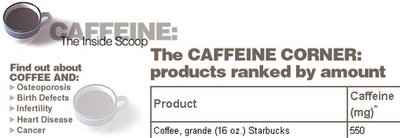
Speaking of take-out coffee, about 10 years ago, the Center for Science in the Public Interest (CSPI) published the table below which drew attention to the caffeine content of Starbucks' brewed coffees:


Starbucks doesn't divulge caffeine content on their website. But an article from Newhouse News Service (NNS) in 2003 reported finding "anywhere from 259 to 564 milligrams of caffeine" in 16 oz. Starbucks' samples. They contacted a Starbuck's rep:
"Lara Wyss, spokeswoman for the Seattle-based Starbucks Coffee Co., said in a statement that "many variables contribute to caffeine levels in coffee from cup to cup," including type of bean, roast, brewing method, grind and coffee maker. Starbucks customers can expect an average of 200 milligrams of caffeine per 8 ounces, she added."

That equates to 300 mg. caffeine for a Starbucks' 12 oz. "tall", and 400 mg. for a 16 oz. "grande". Quite a jolt.

Wednesday, February 22, 2006

Coffee's Many Components


While I'm talking about coffee, it's only fair to mention some other aspects.

Below are three more studies. Two suggest that the caffeine in coffee can increase blood glucose (BG) and make cells more resistant to insulin after a meal. The third finds benefits in coffee's non-caffeine phenolic compounds.

There are differences that set these studies apart from the ones just posted which discussed coffee's possible role in reducing the risk for diabetes.

  1. Their study populations were small, 14 and 9, compared to several thousands in the previous studies.

  2. The first two studies tested the effect of just one chemical in coffee, caffeine, rather than the complete beverage.

There are a number of biologically active molecules in coffee. Some, unlike caffeine, may improve measures of glucose tolerance. An example of this is documented in the third study below. It found that, although the caffeine in coffee increased post-meal blood glucose, another component, chlorogenic acid, slowed the rate of absorption of glucose, resulting in a lower post-meal BG than if it had not been consumed.

1. Diabetes Care, August 2004
Caffeine Impairs Glucose Metabolism in Type 2 Diabetes

The study group consisted of 14 people, average age 61, with type 2 diabetes. The intervention group received 375 mg of pure caffeine. After a meal, blood glucose levels were 21% higher among caffeine-takers when compared to a non-caffeine control group; blood insulin was 48% higher.

2. American Journal of Clinical Nutrition, July 2004
Caffeine Ingestion Increases the Insulin Response to an Oral-glucose-tolerance Test in Obese Men Before and After Weight Loss

The study group consisted of 9 obese, non-diabetic men, age 23-34.
Caffeine ingestion (5 mg/kg body weight, about 475 mg caffeine for a 210 lb man) was found to decrease a measure of insulin sensitivity by 15%.

3. American Journal of Clinical Nutrition, October 2003
Coffee Acutely Modifies Gastrointestinal Hormone Secretion and Glucose Tolerance in Humans: Glycemic Effects of Chlorogenic Acid and Caffeine

The study group consisted of 9 non-diabetic men and woman, average age 26. Participants were given instant caffeinated coffee, instant decaffeinated coffee, or glucose water. Components in coffee, possibly chlorogenic acid, were found to decrease the rate of intestinal absorption of glucose.

Wednesday, February 15, 2006

Coffee and Diabetes


The following two studies are in no way definitive in regards to coffee consumption and risk for diabetes. But they do add fuel to the notion that drinking coffee can be beneficial - at least when it comes to fending off a diagnosis of diabetes.

  1. The first appeared in the International Journal of Obesity last May (2005). It found that drinking caffeinated coffee or tea decreased the risk for type 2 diabetes, while decaffeinated versions had little effect. It should be noted that the decrease in risk applied only to those who also lost weight during the study.

    The study included over 7000 participants of the follow-up to the National Health and Nutrition Examination Study (NHANES).

  2. The second appeared in this month's issue of Diabetes Care, a few pages beyond the study just posted about whole grains.

    It also found that drinking caffeinated coffee reduced the risk for type 2 diabetes, by 13% for one cup/day to 47% for four or more cups. However, unlike the first study it found benefit for decaffeinated coffee also.

    The study included over 88,000 women who participated in the Nurses Health Study II.

________

For the May study:
Coffee, Tea and Diabetes: The Role of Weight Loss and Caffeine

ADA's brief on the May study:
Coffee, Tea, and Diabetes

For the Diabetes Care study:
Coffee, Caffeine, and Risk of Type 2 Diabetes

Diabetes Care news summary:
Coffee May Lower Risk of Type 2 Diabetes