Showing posts with label Meters. Show all posts

Thursday, July 26, 2007

Storing Glucose Test Strips

In the warmer and more humid conditions of summer, it's important to store your test strips and meter away from heat and direct sunlight. Heat and moisture can damage both the strip and the meter.

Manufacturers package instructions with strips that include information on their use during spells of unusual heat and humidity. Some manufacturers recommend storing strips in a dry place at room temperature, between about 68 to 86 degrees F. (This may preclude the bathroom.) Some advise against storing in the refrigerator. Those that allow refrigeration may state that strips should be brought to room temperature before using.

If you've recently weathered a storm, power outage, or other situation that exposed your strips to extreme conditions, refer to the instructions packaged with your strips. It wouldn't be a bad idea to run a control solution or control strip through your meter as a test.
________

Wednesday, October 18, 2006

Counterfeit OneTouch® Test Strips


If you use a OneTouch® meter by LifeScan, check your test strips. LifeScan has reported finding counterfeit strips for some of its meters. When analyzed, these strips showed "erratic test results that [did] not meet LifeScan's performance specifications."

According to LifeScan, counterfeit strips can be identified by the following:

Counterfeit OneTouch Ultra Test Strips

  • Multiple Languages - English and French text on the outer carton.
  • Lot Number 2691191 and 2691261 (Located on outer carton and vial).
  • Limited to 50-Count OneTouch Ultra Test Strip packages.
  • No NDC number (located on the bottom of the outer carton for US product).

Counterfeit OneTouch (Basic/Profile) Test Strips

  • Multiple Languages - English, Greek and Portuguese text on the outer carton.
  • Lot Numbers 272894A, 2619932 or 2606340 (Located on outer carton and vial).
  • Limited to 50-Count OneTouch (Basic/Profile) Test Strip packages.
  • No NDC number (located on the bottom of the outer carton for US product).

If you spot the above on your strips, visit LifeScan's press release for confirmation and a course of action:
Counterfeit Test Strips Discovered in United States: OneTouch® Ultra® and OneTouch® Basic®/Profile® Test Strips

Monday, August 28, 2006

GlucoTel's BG Meter - First to Support Wireless Bluetooth


A new blood glucose monitoring system was exhibited at the American Diabetes Association's (ADA) 66th Scientific Sessions this year which takes advantage of wireless technologies.

The GlucoTel BG meter was designed to be one of the smallest meters in the current line-up, and one that will be able to transmit data to a cellphone via a wireless Bluetooth connection, and to a database via the cellphone. This enhanced communication may facilitate treatment changes:
"Glucose readings taken by the meter are automatically transmitted to the cellphone, and then forwarded in encrypted form to a server where the data is stored in a web-accessible database. The patient also enters insulin dosage data into the phone which is transmitted to the database. The data can then be reviewed at a call center to track the patient’s history in achieving target goals for glycemic control. If adjustments in the patient’s diabetes management protocol are needed, the patient’s physician or disease management coordinator can call to prescribe the changes, such as an altered insulin dosage schedule."
- Michael Simonsen, Insulin delivery and continuous monitoring top diabetes market, Biomedical Business & Technology, August 2006

The GlucoTel BG meter is due for launch in January, 2007.
________

For GlucoTel's site:
www.glucotel.com

Monday, July 17, 2006

Bayer Acquires Metrika, Along With A1CNow+®


A glycated hemoglobin test (HbA1C or A1C for short) is a measure of blood sugar control during the past 2 to 3 months. Where a home blood glucose (BG) meter can tell you what your sugar is at a particular moment, an A1C test provides, in effect, an average of BG levels over the last few months.
The American Diabetes Association has a great fact sheet on the A1C test.

Both types of tests, BG self-monitoring and the A1C, are needed for effective control. Since the A1C is an average, it's not useful for making specific adjustments to your insulin or other treatments. Nor can it tell you if you've had very high or very low sugars recently. But it can pick up what's going on with your sugars in between the times you test, giving you a broader picture.

The A1C test was traditionally performed by a blood draw, with analysis either in a lab or doctor's office. The attractiveness of the newer at-home A1C tests, no doubt, factored into Bayer's recent acquisition of Metrika, manufacturer of the popular A1CNow+® meter:
"We are very excited to now offer people with diabetes and their healthcare providers the first and only device for use both at home as well as in the professional setting for monitoring of HbA1c."
- Sandra Peterson, President of Bayer Diabetes Care

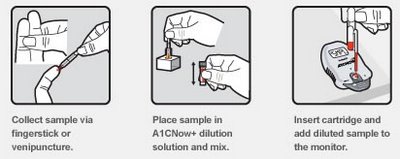
The A1CNow+® test is similar, but not the same, as a BG test. It requires a slightly larger blood sample (5 microliters), takes 5 minutes to calculate results, and is performed in 3 steps:


- From Metrika's A1CNow+ Overview site.


The A1C Now+ is currently available in a 10-test-then-dispose version. Look for a 2-test version this fall.

________

Metrika's press release:
Bayer Acquires Metrika Inc.

Tuesday, April 18, 2006

Medtronic's Insulin Pump with Glucose Monitor Gets FDA Approval


In a healthy person, the body senses insulin need and dispenses the hormone without the person's conscious thought or action. Future technologies may one day be able to mimic this unconscious sensing and dispensing of insulin for people with diabetes.

Last week, medical science moved a step closer to such a "closed loop" system with the FDA's approval of Medtronic's insulin pump and glucose monitoring system.

The MiniMed Paradigm® REAL-Time Insulin Pump and Continuous Glucose Monitoring System sends glucose readings every 5 minutes from a sensor to the pump. These continuous readings allow a user to monitor their glucose throughout the day. The system includes an alarm that vibrates or sounds when blood glucose is too high or too low, especially useful when sleeping. Action can be taken to improve glucose levels after a fingerstick confirmation.

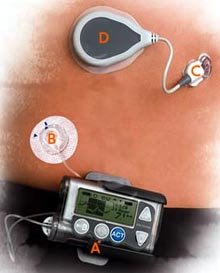
MiniMed Paradigm® REAL-Time Insulin Pump and Continuous Glucose Monitoring System"Integrating an insulin pump with REAL-Time CGM is a major step toward the development of a “closed-loop” insulin delivery system that may one day mimic some functions of the human pancreas."
- Medtronic's press release

MiniMed's REAL-Time System is shown at right:
A - Insulin pump
B - Insulin delivery
C - Glucose sensor
D - Transmitter

If you're interested in just continuous glucose monitoring (CGM) without a pump, MiniMed currently sells the Guardian® RT CGM System.

Or you can buy the MiniMed Paradigm 522/722 insulin pump and use it without the glucose monitoring system. Later, if you decide to try continuous monitoring, you can purchase the REAL-Time Continuous Glucose Monitoring Kit, designed to be used with those pumps. The monitoring kit should be available this summer.

________

For Medtronic's press release:
Medtronic Receives FDA Approval for World's First Insulin Pump with Real-Time Continuous Glucose Monitoring

Friday, December 23, 2005

FDA Warns LifeScan About Its Meters

On December 7, the FDA sent a warning letter to LifeScan, Inc. concerning possible incorrect measurements on its blood glucose monitors. The letter was posted on the FDA's site on December 20. You can read it here.

The letter was a culmination of correspondence between LifeScan and the FDA which began in April when the FDA sent inspectors to LifeScan's California plant. Shortly after that inspection began, LifeScan posted a press release discussing possible issues with its meters:

If you use a OneTouch® Ultra®, OneTouch® FastTake®, InDuo®, EuroFlash®, or SmartScan® Meter, we want to make you aware of two possible issues regarding these products.
  1. Your meter is designed to show results in two different units of measure. When setting your meter's date and time, it is possible for you to accidentally change the unit of measure.
  2. Very rarely, an event such as dropping your meter while in use can cause a brief power loss. As a result, the meter may unexpectedly change the unit of measure and/or the code number.
- LifeScan Press Release, April 14, 2005

If you'd like to check your meter, visit LifeScan's site for more information including correct device settings. You'll find a list of contact phone numbers and an email response form there too.

________

For the FDA's warning letter:
LifeScan, Inc. Warning Letter

For LifeScan's page on how to check your meter:
URGENT: MEDICAL DEVICE CORRECTION -- OneTouch® Ultra®, OneTouch® FastTake®, InDuo®, EuroFlash® and SmartScan®

Some news summaries:
FDA Warns About Faulty Blood Sugar Monitors
FDA Warns Maker of Blood-Sugar Monitors

Friday, August 26, 2005

Abbott's Freestyle Connect™ - FDA Approved

On August 15, Abbott received the nod from the FDA to market their newest blood glucose monitor, the Freestyle Connect™ *

As with other Freestyle meters, the Connect™ requires just a 0.3 micro liter blood sample, the smallest of any like product on the market. Their newest model claims speed (15-second results) and outstanding accuracy.

The meter will be available this month to hospitals and other medical settings.

________

For Abbott's press release:
Abbott Receives FDA Clearance to Market Freestyle Connect™ Blood Glucose Monitoring System

For Abbott's Freestyle product information:
Diabetes Health Connection: Freestyle Blood Glucose Monitoring System

* Abbott has discontinued the Freestyle Connect Data Management System.

Tuesday, August 23, 2005

Medtronic's Guardian® RT - FDA Approved

It doesn't do away with fingerstick testing entirely, but Medtronic's Guardian® RT continuous glucose monitoring system, approved by the FDA on August 10, is a step in that direction.

From Medtronic's Press Release:
The Guardian® RT System records as many as 864 glucose readings during a three-day period using a disposable glucose sensor that connects to a transmitter and communicates to a monitor using radio frequency. The sensor measures glucose in the interstitial fluid found between the body’s cells, and is typically discarded and replaced by the patient after three days of use. Glucose measurements are relayed every five minutes from the transmitter to the monitor, which displays the glucose values on its screen.

The monitor described above is actually a small screen on a portable pager-like device. The glucose sensor is a tiny electrode that must be inserted under the skin but is good for up to 288 glucose readings a day, for three days. Fingersticks are still needed twice a day to calibrate the glucose sensor, and to verify a possible hypoglycemic or hyperglycemic condition. The System is intended for management of either type 1 or type 2 diabetes, for those over 18 years of age.

________

For Medtronic's press release:
Medtronic Announces FDA Approval Of Real-Time Continuous Glucose Monitoring System

For Medtronic's product information:
Guardian® RT Continuous Glucose Monitoring System